
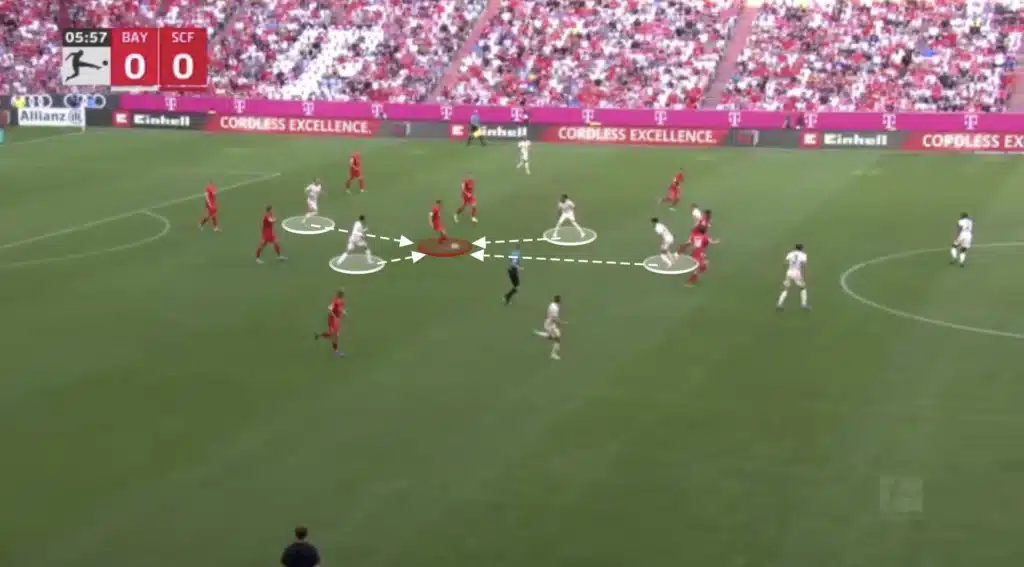
Gegenpressing, also known as pressing after loss or counter-pressing, is one of the most influential tactical strategies in contemporary football. It is a playing philosophy that combines intensity, collective coordination, and offensive aggression, capable of turning ball recovery into an immediate attacking tool.
Although popularized by Jürgen Klopp with his teams at Borussia Dortmund and Liverpool, the concept has older roots and represents an evolution in the way football is understood: attacking through defense.
What is Gegenpressing?
The term Gegenpressing comes from German and literally means “counter-pressing.” Its essence is simple but demanding: when a team loses possession, it does not retreat but immediately pressures the opponent to regain the ball as quickly as possible.
The logic is clear: the opponent who has just gained possession is not yet organized to attack, making them more vulnerable. If the ball is won back in those first few seconds, the recovering team can create immediate goal-scoring opportunities, taking advantage of the opponent’s disarray.
Gegenpressing is therefore based on intensity, synchronization, and courage. All players participate in the collective effort: the one who loses the ball presses immediately, while the rest close passing lanes to prevent the opponent from playing out cleanly.
Origins of Gegenpressing
Although often associated with Jürgen Klopp, Gegenpressing was not created by him. Its origins date back to 1980s Italy, when the legendary Arrigo Sacchi, coach of AC Milan, revolutionized football with his concept of collective pressing.
Sacchi understood that “pressing is not just running after the opponent, but controlling space,” an idea that forever changed defensive thinking. Under his guidance, Milan won two European Cups by applying coordinated high pressing that prevented the opponent from building their play.
Decades later, German coaches such as Wolfgang Frank —Klopp’s mentor at Mainz 05— and Ralf Rangnick refined that philosophy, introducing more vertical and dynamic variants. Klopp adapted it to his own style, dubbed by the press as “Heavy Metal Football”: a high-tempo game with rapid transitions and constant intensity.
How Gegenpressing Works
Implementing Gegenpressing requires exceptional physical preparation and a compact tactical structure. Players must be fit enough to maintain intense pressing for the full 90 minutes and mentally prepared to act as a cohesive unit.
The process begins at the exact moment possession is lost. The player who gave up the ball initiates immediate pressure, while their closest teammates gather around the opposing ball carrier. The goal is to regain possession in under five seconds, before the opponent can reorganize.
For it to work, the team must decide in which area of the field to apply pressure:
In a high area, near the opponent’s penalty box, if the team has intense and fast forwards.
In a mid-field area, if the team aims to control space without exhausting itself too much.
The key lies in collective coordination: each player must know when to press, when to block passing lanes, and when to drop back to avoid being exposed.

Types of Gegenpressing
Although the philosophy is common, there are different ways to apply it. In general terms, three main variants can be distinguished:
Man-to-man Gegenpressing after loss
Each player directly pressures the nearest opponent after losing the ball, preventing long passes and forcing immediate errors.
Ball-carrier Gegenpressing
The pressure focuses on the player in possession, surrounding them and limiting their space. It is the most aggressive and effective version when executed quickly.
Passing-lane closure Gegenpressing
Instead of pressing the ball holder, the passing options are blocked. This forces the opponent to play in compromised areas and facilitates ball recovery to launch an offensive transition.
How to Counter Gegenpressing
At first glance, Gegenpressing may seem like an impossible tactic to counter, but there are effective strategies.
The main strategy is to maintain a high defensive line and play quick one- or two-touch football. This reduces the opponent’s reaction time and prevents falling into their pressing trap.
Teams with technical and precise players can break the block through vertical passes or changes of direction, exploiting the spaces left by a very advanced setup. The key is to overcome the first line of pressure; once that is achieved, the opponent is exposed defensively.
Teams and Coaches of Gegenpressing
In addition to Klopp’s Dortmund and Liverpool, Gegenpressing has been successfully applied by coaches such as:
Ralf Rangnick, at Hoffenheim and RB Leipzig.
Julian Nagelsmann, who perfected it at Leipzig and Bayern Munich.
Hansi Flick, with Bayern Munich, European champions in 2020.
Even coaches with different philosophies, such as Pep Guardiola or Marcelo Bielsa, have incorporated elements of pressing after loss into their systems, demonstrating the versatility and relevance of this tactic.
A Paradigm Shift
More than just a strategy, Gegenpressing represents a conceptual revolution in modern football.
It transformed pressing—previously seen only as a defensive tool—into an offensive weapon. It introduced a collective mindset in which all players attack and defend in unison, eliminating the separation between both phases of play.
Today, Gegenpressing is not just a tactical trend but a global philosophy. It has redefined the way possession, intensity, and teamwork are understood. In Klopp’s own words:
“No game creator in the world can be as good as a good gegenpressing situation.”
And it is precisely this idea — that of creating from recovery, attacking from pressure — that explains why Gegenpressing is not just another tactic, but a modern way of conceiving football.